
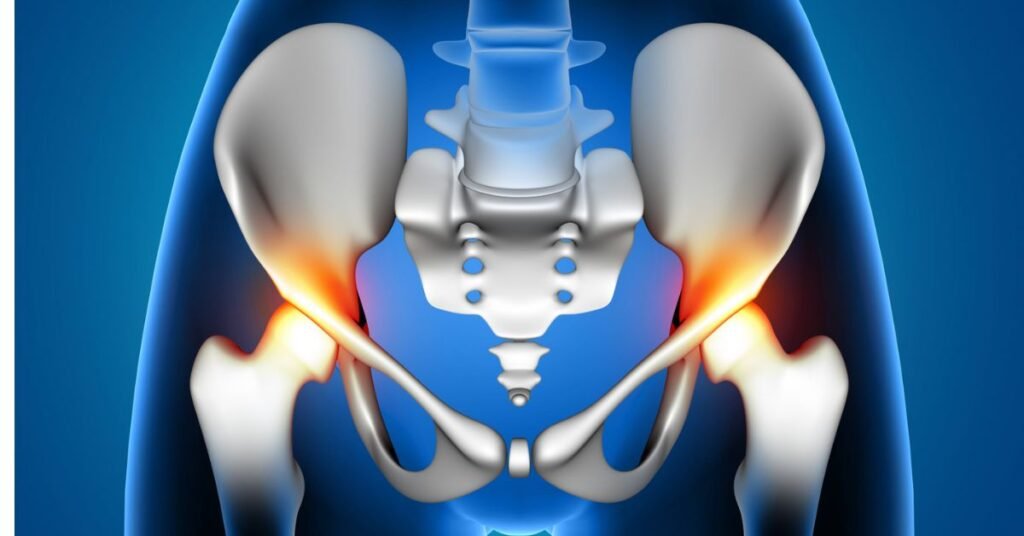
Hip pain has a way of quietly shrinking your life. Stairs become a calculation. A short walk turns into a decision. Sleep gets interrupted. If you’ve reached the point where your doctor has raised total hip replacement, or you’re researching it on your own because daily pain has become hard to ignore, this guide is meant to answer the questions that actually matter — what the surgery involves, what recovery really looks like, and how to choose the right surgeon in Indore.
What Is Total Hip Replacement Surgery?
The hip is a ball-and-socket joint: the “ball” is the top of your thighbone (femoral head), and the “socket” is a cup-shaped part of your pelvis (the acetabulum). In a healthy hip, cartilage lets these two surfaces glide smoothly. When that cartilage wears away — from osteoarthritis, avascular necrosis, old trauma, or inflammatory arthritis — bone rubs on bone, and the result is pain, stiffness, and a shrinking range of motion.
Total hip replacement (also called total hip arthroplasty, or THA) removes the damaged ball and socket and replaces them with an artificial implant, typically a metal or ceramic ball paired with a durable plastic, ceramic, or metal socket liner, anchored into the pelvis and thighbone. The goal isn’t just pain relief — it’s restoring a joint that moves the way a healthy hip should.
Who Is a Candidate for Hip Replacement?
Hip replacement is generally considered when:
- Hip pain significantly limits walking, working, or basic daily activities
- Pain persists despite consistent non-surgical treatment — physiotherapy, weight management, medication, and activity modification
- Stiffness makes it difficult to put on shoes, get in and out of a car, or climb stairs
- Imaging confirms significant joint damage that matches the severity of your symptoms
There’s no single “right age” for hip replacement. The decision is based more on how much the joint is affecting your life and function than on a birthday. That said, the surgeon will also weigh your overall health, bone quality, and activity goals when discussing timing.
Anterior vs. Posterior Approach: What’s the Difference?
One of the most common questions patients ask is which surgical approach is “better.” The honest answer is that both are well-established, safe techniques — the right one depends on your anatomy, the surgeon’s expertise, and your specific case.
Posterior approach accesses the hip joint from the back, through a 4–6 inch incision. It’s the most widely used and longest-established technique globally, with a strong safety track record, including for patients with more complex hip conditions or previous surgeries. Because some muscles and tendons are detached and later repaired, recovery is typically longer, and specific hip precautions — avoiding certain bending, twisting, or leg-crossing positions — are usually followed for several weeks after surgery while tissues heal.
Anterior approach accesses the joint from the front of the hip, working between muscle groups rather than cutting through them, which is why it’s often described as “muscle-sparing.” Patients undergoing this approach often experience a shorter hospital stay and a somewhat faster early recovery, and it typically comes with fewer post-surgical movement restrictions. It’s technically more demanding for the surgeon and isn’t equally suited to every patient’s anatomy.
Neither approach is universally superior — both have decades of successful outcomes behind them. The right choice comes down to a conversation with your surgeon about your specific hip anatomy, any prior surgeries, and their own experience and outcomes with each technique.
What Happens Before Surgery
Pre-operative preparation typically includes a full clinical evaluation, imaging (X-rays, sometimes additional scans), blood work, and an anesthesia assessment. Your surgeon will also review your current medications, since some may need to be paused beforehand. Many hospitals now use “enhanced recovery” protocols — a structured approach to pre-surgical preparation, pain management, and early mobilization designed to help patients recover faster and more comfortably.
This is also the stage to prepare your home: a stable chair with arms, a raised toilet seat, removal of loose rugs or trip hazards, and arranging for help during the first days after discharge all make early recovery noticeably smoother.
What Happens During Surgery
Total hip replacement is typically performed under spinal (regional) or general anesthesia, and the procedure itself generally takes one to two hours, depending on complexity and approach. The damaged femoral head and cartilage-worn socket are removed and replaced with the prosthetic components, which are fitted and secured within the existing bone structure. Modern implants are designed for durability, and surgeons select component size and positioning based on your individual anatomy and pre-operative imaging.
Recovery Timeline: What to Expect
Every patient’s timeline varies, but a general pattern looks like this:
Day of surgery to discharge: Most patients are encouraged to sit up and begin gentle movement within hours of surgery. Hospital stay after a posterior approach is often several days; after an anterior approach it may be shorter, sometimes just a day or two, depending on the individual case and hospital protocol.
First 1–2 weeks: Walking with a walker or crutches, working with a physiotherapist on basic mobility, and managing swelling and discomfort with prescribed pain management. Most people are up and moving around the house during this stage.
2–6 weeks: Progression to a cane and, for many patients, gradual return to daily activities. Driving is often possible once you’re off strong pain medication and can comfortably control the vehicle, but always confirm this milestone with your surgeon.
6 weeks to 3 months: Continued strength and mobility gains through physiotherapy. Patients on the posterior approach are often transitioning out of formal hip precautions around this window; those on the anterior approach may have reached this stage of freedom of movement earlier.
3–6 months and beyond: Most patients report substantial pain relief and markedly improved function well before the one-year mark, with continued fine-tuning of strength and stamina over the following months.
Recovery speed depends heavily on your pre-surgery fitness, adherence to physiotherapy, overall health, and the surgical approach used — so treat any timeline as a general guide, not a guarantee.
How Long Does a Hip Replacement Last?
Modern hip implants are built for durability, and a large proportion of patients get many years, often decades, of reliable function from a single implant. Longevity depends on implant type, activity level, body weight, and individual bone health. Some patients eventually need a revision hip replacement if the implant wears down or loosens over time — this is a normal part of long-term joint replacement planning rather than a sign that something went wrong with the original surgery.
Questions to Ask Before Your Surgery
A good surgical consultation should leave you confident, not just informed. Consider asking:
- Which surgical approach do you recommend for my case, and why?
- How many total hip replacements have you performed, and what is your outcomes experience?
- What implant type are you planning to use, and why is it suited to me?
- What does my specific recovery timeline and physiotherapy plan look like?
- What are the realistic risks in my case, given my health history?
- What hospital and post-operative support will I have access to?
An experienced surgeon should be able to answer these clearly and specifically to your case, not with generic reassurance.
Choosing a Hip Replacement Surgeon in Indore
Indore has a growing number of orthopedic surgeons offering joint replacement, so it’s worth evaluating a few things beyond a single online review: the surgeon’s specific fellowship training in arthroplasty, their volume of hip replacement cases, the hospital’s infrastructure for joint replacement (including physiotherapy and post-operative care), and whether they take time to explain your specific case rather than pushing a one-size-fits-all recommendation.
Dr. Sanjay Rawat is a Consultant Arthroplasty and Joint Replacement Surgeon at Shalby Hospitals, Indore, focused specifically on advanced knee and hip replacement surgery. If you’re weighing your options for hip pain that hasn’t responded to conservative treatment, a direct clinical evaluation is the most reliable way to understand where you stand and what approach fits your case.
Total hip replacement is one of the most consistently successful surgeries in modern orthopedics, with a strong track record of restoring mobility and quality of life for patients whose hip pain has stopped responding to conservative care. Understanding the procedure, the approach options, and a realistic recovery timeline can make the decision — and the recovery itself — far less daunting.
FAQs
How long does total hip replacement surgery take?
The procedure itself generally takes one to two hours, though total time in the operating room including anesthesia may be longer.
Is hip replacement surgery painful?
Some discomfort is expected, but modern pain management protocols are designed to keep it well controlled from surgery through recovery.
How soon can I walk after hip replacement?
Most patients begin walking with support, such as a walker, within hours to a day after surgery.
What’s the difference between anterior and posterior hip replacement?
The anterior approach accesses the hip from the front, working between muscles rather than cutting them, often allowing faster early recovery with fewer restrictions. The posterior approach, accessed from the back of the hip, is the most widely used technique with a strong long-term track record, generally involving a longer recovery and temporary movement precautions.
How long does a hip implant last ?
Many patients get years, often decades, of reliable function from a single implant, though this varies by implant type, activity level, and individual health factors.
When can I drive after hip replacement?
This varies by patient, but many people can resume driving once they’re off strong pain medication and can control the vehicle comfortably and safely — always confirm with your surgeon first.
What are hip precautions and how long do I need to follow them?
These are movement restrictions, such as avoiding deep bending or leg-crossing, meant to protect the joint while it heals. They’re more commonly required after a posterior approach and typically last several weeks.
How do I know if I need a total hip replacement or if non-surgical treatment is still an option?
his depends on your specific symptoms, function, and imaging findings — a clinical evaluation with an orthopedic surgeon is the only reliable way to know.
Living with constant hip pain can affect every part of your daily routine, from walking and climbing stairs to enjoying simple activities with family and friends. If hip discomfort is limiting your mobility and quality of life, it may be time to explore your treatment options. Schedule an orthopedic evaluation with Dr. Sanjay Rawat to understand the cause of your pain and receive personalized guidance on hip replacement surgery. For appointments or inquiries, call +91-9244044779 or visit RS Bhandari Marg, Race Course Road, Indore.