Total Elbow Replacement Surgery in Indore
- Home
- Total Elbow Replacement Surgery in Indore
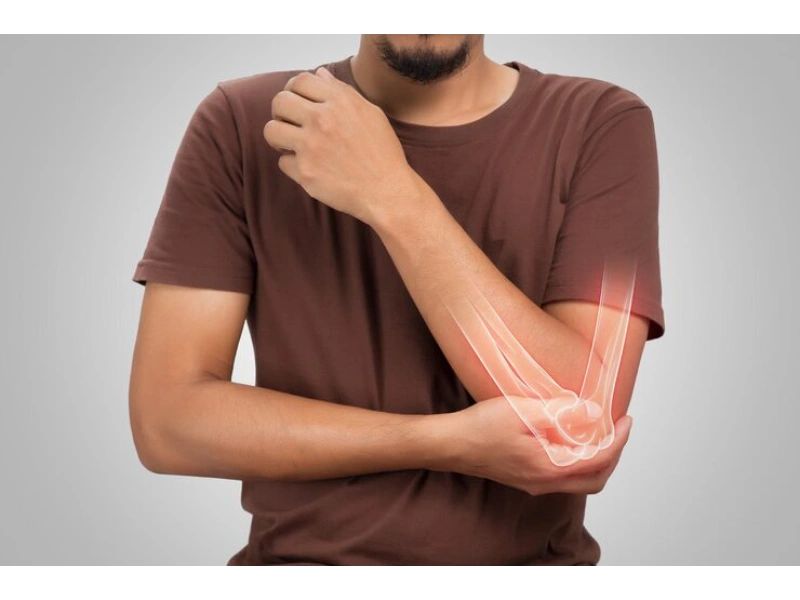
Total elbow replacement, or total elbow arthroplasty (TEA), is a surgical procedure to replace a damaged or very arthritic elbow with a plastic artificial joint. The prosthesis will use metal and plastic parts which are similar to the movement and function of a healthy elbow.
The humerus (upper arm bone), the radius (lateral forearm bone), and the ulna (medial forearm bone) are the three bones that make up the elbow joint. These bones move together at the elbow to enable the complex ranges of elbow flexion (bend), extension (straighten), pronation (palm down) and supination (palm up).
Total elbow replacement is performed less frequently than the total hip and knee replacement, and is usually reserved for certain indications where conservative treatments have failed and the damage to the elbow is extensive. This is especially useful for patients whose elbow pain and dysfunction is debilitating to their ability to live their lives.
Total elbow replacement is only considered for those with significant arthritis of the elbow joint, who have failed to improve with conservative therapy and are suffering from elbow pain. One of the most common symptoms is rheumatoid arthritis, which can result in more severe damage to the elbows than that resulting from osteoarthritis of the elbow.
Previous elbow injuries that happened months or years ago, such as fractures around the elbow joint (supracondylar fractures, distal humerus fractures, radial head fractures) can lead to osteoarthrosis of the elbow.
Post-traumatic arthritis is the condition that occurs years after major injuries of the elbow or following surgery. This is cartilage damage from the previous injury that slowly progresses to progressive arthritis which ultimately needs replacement.
Elbow instability that is severe and causes repeated dislocations or significant ligament damage may necessitate elbow replacement surgery, especially if the patient’s function or quality of life has been greatly affected.
If the previous elbow surgeries or failed internal fixation of elbow fractures have failed, total elbow replacement may be necessary to restore function and relieve pain.
Elbow is a compound hinge joint between distal humerus and proximal radius and ulna. Joint capsule, ligaments and muscles contribute stability and movement.
Articular cartilage is the tissue covering the surfaces of the joints which allows them to move smoothly without friction. This cartilage has a thickness of ~ 2-3mm and serves to absorb the impacts and spread the load.
The radial and ulna also join each other and the humerus, allowing for the movement of pronation and supination. Different ligaments in different directions give stability, such as the lateral and medial collateral ligaments.
Movement and stability are provided by muscles such as the biceps (flexes elbow and supinates forearm), triceps (extends elbow) and others. Elbow function is important for hand positioning in space and will greatly affect functional activities.
Patients who need a total elbow replacement often have a progressive pain in the elbow, especially with weight-bearing, gripping, or lifting movements. The pain can be persistent or exercise induced.
Loss of range of motion is frequent and patients may lose flexion and/or extension, or may get a fixed elbow contracture (inability to extend). When loss of pronation and supination occurs, it will make the forearm unable to rotate.
Elbow swelling, often after activity, is common. Stiffness, especially morning stiffness, occurs frequently in rheumatoid arthritis.
Some cases experience elbow instability or the feeling that it “gives way” or “dislocates. Patients comment on their poor functional abilities, for example reaching to face, grooming, feeding and personal hygiene.
Clinical examination evaluates elbow pain and range of motion, elbow stability and neurovascular status. It is important to assess nerve function since the ulnar nerve is located on the inside of the elbow.
X-rays show narrowing spaces between the joints, bone spurs and general joint damage. They help to plan surgery and determine the kind of prosthesis to use.
In complex cases, a CT scan may be requested to evaluate the amount of bone, and anatomy.
RA patients frequently have joint disease and a complete evaluation of overall disease status and function is critical.
Consultation with a rheumatologist is often obtained in patients with rheumatoid arthritis to optimize medical management and ensure overall health is appropriate for surgery.
When Total Elbow Replacement Is Recommended
The total elbow replacement is indicated when patients have severe elbow arthritis or damage that results in elbow pain and functional loss, conservative treatments have failed, the patient has realistic expectations for surgery and recovery, and there is a lack of overall health contraindications to surgery.
The patient should be advised that TEA is a procedure performed only in certain circumstances, and that if they have a specific pathology, alternative methods (debridement with arthroscopic cleaning or other options may be discussed first).
General anaesthetic is generally used for a total elbow replacement. Patient is lying on their back with the elbow showing. A tourniquet is often applied to minimize bleeding.
A rear incision is made over the back of the elbow, usually parallel to the ulnar nerve and bringing the nerve into the incision (in-situ approach) or bringing the nerve under the incision to give the surgeon a better view of the joint (transposition approach).
The triceps muscle is reflected to expose the underlying elbow joint and its supporting ligaments. Soft tissues are treated with care to ensure that they remain stable following replacement.
The damaged articular surfaces are removed from the distal humerus and proximal radius and ulna. Bone is ready for the introduction of a prosthetic part.
Prosthetic parts are placed into and fixed into bone. The vast majority of total elbow prostheses are either press fit or cemented. This design and fixing method will vary based on patient’s factors and surgeon’s preference.
Elbow motion and stability is checked prior to soft tissue closure. The triceps muscle is reattached to bone and the surgical incision is closed in layers.
If the design includes the radial component, which attaches to the lateral forearm bone, the total elbow prostheses have three parts: a humeral component (attaches to the upper arm bone), an ulnar component (attaches to the main forearm bone), and a radial component (attaches to the lateral forearm bone).
The articulating surfaces are typically metal to plastic (metal humeral and ulnar components articulating against a plastic insert), or more recent designs with metal-on-metal articulation.
The degree of constraint in the designs range from less constrained designs that mimic the natural elbow and distribute loads in a more natural manner, to more constrained designs that provide more inherent stability, but result in higher stress at the implant-bone interface.
Long term survival rates (>15-20 years) for most studies are quite high for modern prostheses, which are now much improved in terms of durability and maintenance.
The main benefit is dramatic pain relief with most patients having a substantial or complete resolution of elbow pain after the surgery.
These often lead to greater range of motion and functional use of the elbow which subsequently improve the ability to position the hand and use the elbow as a functional joint.
Functional activities such as eating, grooming and reaching as well as the use of the arm as a normal tool greatly enhances the quality of life.
This technique is especially useful for patients with rheumatoid arthritis who have damaged elbows and sustained significant pain compromising their elbow function.
Very good long-term pain relief and functional improvement is generally achieved and the vast majority of patients are very satisfied with the procedure.
The procedure of total elbow replacement has its limitations compared to hip and knee replacement, due to the complexity of the function and anatomy of the elbow, and the relative rarity of the procedure.
There are more restrictions on activity than in hip or knee replacement; heavy lifting, high impact activities or contact sports should be avoided to prevent damage to the prosthesis. Weight bearing on the arm is limited as opposed to weight bearing on the legs.
The non-cemented parts may require time to become fixed and grow into the bones. Over time some components may loosen up, but current designs have made significant strides in this area.
The soft tissue handling of the procedure is very important; if the elbow ligaments and/or the function of the triceps are lost, it will impact the outcome.
The functional demands in the elbow may be higher and so may be the prosthetic longevity compared to hip and knee replacements.
Total elbow replacement recovery is a process that should be treated carefully to ensure the recovery of the prosthesis during its early healing phase. Regardless of pain, it is an important part to manage and pain should be reasonably controlled with medication.
Immobilisation in the brace is common for the first several weeks to minimize soft tissue healing stress and allow bone to fuse with the prosthetic parts.
Early motion starts as soon as the pain limits it, to prevent stiffness and to protect healing soft tissues, protected range of motion exercises are initiated.
Formal physical therapy usually starts within a few weeks after surgery with gentle ROM (range of motion) and progressive strengthening.
Initially lifting and weight bearing through the arm was limited and then progressed gradually during healing.
Recoveries are usually 3-6 months in duration, and at times improvements will be seen after.
Early physical therapy is designed to increase pain tolerance with gentle ROM exercises. Special care is taken to ensure that the healing soft tissues are not stressed through a gradual progression of the exercises.
Strengthening exercises for the triceps and other arm muscles are progressively advanced. Activities are gradual and carefully monitored to not stress the prosthesis.
Functional training assists patient to regain ability to perform activities of daily living. Patients are taught correct body positioning and movement for functional activities to minimize stress on the elbow.
Exercise regimes are done at home every day and are key to optimum recovery.
Healing and recovery from injury usually takes 3-6 months to get back to everyday life. Heavy lifting and vigorous activities should be avoided to protect the prosthesis, in general, indefinitely.
After healing, low impact activities like walking, golf, and other recreational activities can generally be resumed.
Even after full recovery, heavy lifting, repetitive forceful gripping or activities with high impact are discouraged to reduce stress on the prosthesis and maximize longevity.
Long-term studies have shown that total elbow replacement is a reliable treatment that allows patients to enjoy a good range of pain-free motion and function when the procedure is performed on an appropriate patient. In most series, success rates (good or excellent outcomes and pain relief, and improved function) are well over 90%.
Overall, the longevity of prostheses is very good and survival rates (prostheses that have not required revision) are around 80-90% on 10-15 year follow-up.
The older and less active the patient, the more likely they are to survive with the use of a prosthesis. Patients with high functional demands, such as younger and more active patients, have higher revision rates.
The overall results of the procedure are very good with a good long-term pain relief and high overall patient satisfaction with the outcome of the total elbow replacement.
Dr Sanjay Rawat has trained and has experience in total elbow replacement. He is knowledgeable in careful patient selection, surgical precision and extensive post-surgical care.
Dr. Sanjay Rawat’s knowledge of the unique factors involved in elbow replacement surgery, such as soft tissue handling, implant choice, and activity limitations to ensure long-term success.
Patient-centered approach, through detailed expectations discussion, realistic outcomes explanation, commitment to maximizing pain control and functional improvement.
If you have severe elbow arthritis or damage causing significant pain and functional limitation, Dr. Sanjay Rawat invites you to schedule a consultation. He will evaluate your elbow condition, discuss treatment options including total elbow replacement, and help you make an informed decision about your care.
RS Bhandari Marg, Race Course Road, Indore, Madhya Pradesh 452003
Patients suffering from severe elbow arthritis, joint damage, fractures, or long-term elbow pain with restricted movement may require Total Elbow Replacement Surgery in Indore. Dr. Sanjaya Rawat provides advanced elbow joint treatment in Indore. For appointments, call +91-9244044779.
An Elbow Joint Replacement Surgeon in Indore specializes in treating damaged elbow joints using advanced surgical procedures to restore mobility, reduce pain, and improve daily function.
Elbow Replacement Treatment in Indore is recommended when medications, physiotherapy, and non-surgical treatments fail to relieve chronic elbow pain and stiffness.
Advanced Elbow Surgery in Indore is commonly performed for severe arthritis, complex fractures, ligament injuries, deformities, and failed previous elbow surgeries.
Dr. Sanjaya Rawat is known as one of the best elbow surgeons in Indore for his expertise in elbow replacement, trauma surgery, and complex joint reconstruction procedures. To consult, call +91-9244044779.
Patients with advanced rheumatoid arthritis, post-traumatic arthritis, severe joint damage, or chronic elbow instability may require Total Elbow Arthroplasty in Indore.
You should consult an Elbow Pain Surgery Specialist in Indore if you experience persistent pain, swelling, stiffness, weakness, or difficulty moving the elbow joint.
Complex Elbow Reconstruction Surgery in Indore may involve joint reconstruction, ligament repair, fracture fixation, implant placement, and correction of severe elbow deformities.
A knee replacement doctor in Indore may suggest medicines, injections, or physiotherapy first. Surgery is recommended only when non-surgical treatment fails. Explore options—call +91-9244044779.
If knee pain is constant, swelling increases, and walking becomes difficult, you may need a knee replacement doctor in Indore for proper evaluation and treatment planning.
Recovery varies based on the specific procedure and individual factors. Most patients begin limited activities within days and return to normal routines within weeks to months. Dr. Sanjay Rawat} will provide a personalized recovery timeline during your consultation.
Comprehensive pain management protocols are implemented, combining medications, physical therapy, and rehabilitation strategies to optimize comfort and function during recovery.
Yes, structured physiotherapy is essential for optimal recovery. Our team provides rehabilitation protocols to restore strength, flexibility, and full functional capacity.
Call +91-9244044779 or email dr.sanjay.rawat@gmail.com to book your appointment. We're located at RS Bhandari Marg, Race Course Road, Indore, Madhya Pradesh 452003.
Many procedures are covered by health insurance. We recommend contacting your insurance provider directly. Our staff can also assist with insurance-related questions.
Yes, consultation services are available in Bhopal, Khargone, Barwani in addition to our primary location in Indore.
Bring all relevant medical records, imaging studies, and a list of current medications. Prepare a detailed description of your symptoms and how they've impacted your daily life.
Regular follow-up visits ensure proper healing, address any concerns, and monitor long-term outcomes. Our team remains available throughout your recovery and beyond.
Most patients gradually return to desired activities based on their recovery progress and Dr. Sanjay Rawat}'s recommendations. The timeline varies based on the specific procedure.
Depending on the procedure and individual factors, some patients are discharged the same day, while others require brief hospitalization. Dr. Sanjay Rawat} will discuss expected hospital stay during your consultation.