
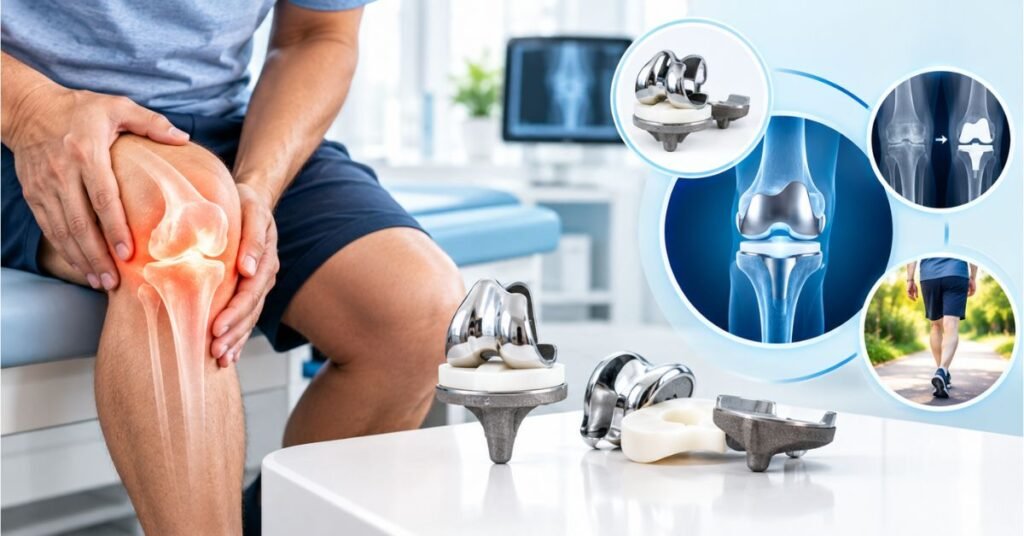
Knee replacement implants are designed to provide a long-lasting joint function, but there are several factors that affect their longevity. Thus, implant longevity should be discussed as a function of patient factors, implant design, activity, alignment, and surgical technique, rather than a single fixed number.
Why Implant Longevity is Important
Knee replacement involves replacing the joint surface with artificial parts. With normal use, wear or changes around the implant can occur with time. Modern materials and better surgical planning have helped make knee replacement a durable treatment option for many patients.
But an implant isn’t necessarily a lifetime solution. Long-term performance can be influenced by factors like patient age, body weight, activity level and the condition of the surrounding bone.
Factors Affecting Implant Survival
There are several factors that may influence implant performance:
• Accurate positioning and alignment
• Selecting the proper implant
• Quality of the bone
• Healthy body weight maintenance
• Minimizing needless high impact loading
• Muscle strength and rehabilitation
• Management of other medical problems
The technique of the knee after surgery is also of importance. Normal walking and routine daily activity is typically different from repeated high-impact activity that places more stress on the joint.
What Monitoring Implants?
The surgeon will also use follow-up visits to assess pain, motion, stability and function. Imaging may be recommended if symptoms occur, or for routine long-term surveillance.
A new pain pattern, swelling, instability or significant decrease in function should not be ignored.
What patients should know
Before surgery, patients can ask their orthopedic surgeon about the implant system that is being considered, why it is a good fit for their knee, expected durability and the surgeon’s follow-up protocol. A knee replacement surgeon in Indore can also tell you how component placement and alignment affect long term function.
Today’s knee implants are designed to last a lifetime, but durability is more than just the implant. Good results are a combination of careful planning, accurate surgery, rehabilitation, and sensible activity. Individual expectations should be discussed with the treating specialist, rather than a universal lifespan of the implant.


