
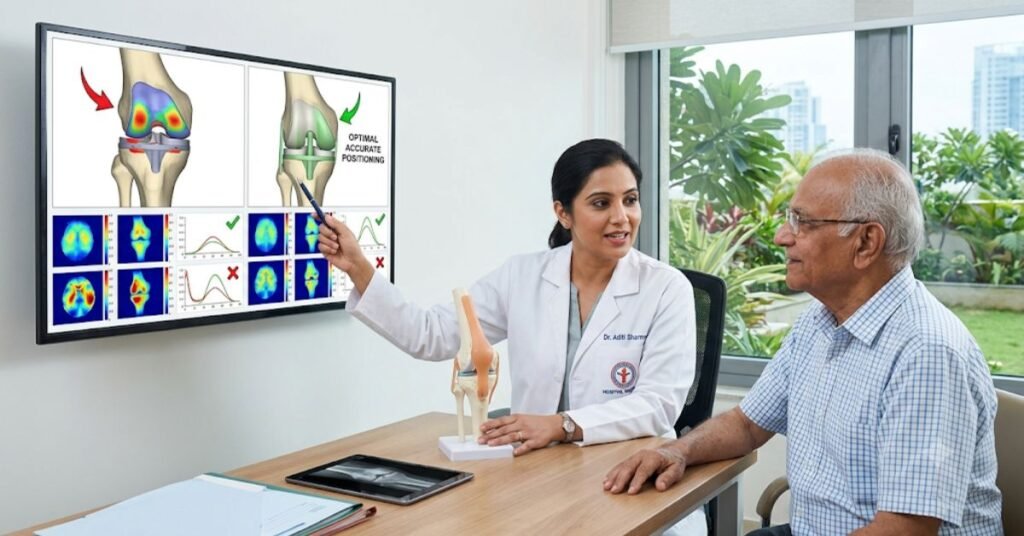
Genu varum is the medical term for bowlegs, which occurs when the knees remain further apart, while the ankles are closer together. In adults, severe bow-legged alignment can sometimes develop with advanced knee arthritis. When the damaged joint causes significant pain and functional limitation, knee replacement may be considered as part of the treatment.
Bowlegs and Knee Arthritis: What’s the Link?
A significant varus alignment can alter load bearing across the knee. Over time this might cause wear and tears in some compartments. Bowlegs have a variety of causes and do not always need surgery. Assessment usually involves symptoms, examination, standing x-rays, and taking into account the patient’s general health.
Can the deformity be replaced?
In some cases, knee replacement can return to the damaged joint surfaces and the abnormal alignment common with arthritis. The surgeon removes the damaged bone, inserts the implant parts, and adjusts the surrounding soft tissues to achieve the planned alignment. The amount of correction is based on the severity and flexibility of the deformity.
What Guides Your Treatment Plan?
- Extent of arthritis and pain
- Deformity (extent and nature)
- Whether the knee is flexible or fixed in place
- Condition of the ligaments and surrounding tissue
- Age, activity and other medical factors
When Conservative Care Still Can Help
If you have bowlegs, you don’t always need a joint replacement. Depending on the cause and severity, symptoms may be helped with exercise-based rehabilitation, activity modification, pain medicines, weight management when appropriate, and other non-surgical measures. A specialist will be able to tell you if you need to correct the deformity. The first step in the treatment of Knee Deformity in Indore is to diagnose the cause and the severity of the deformity.
Knee replacement can correct certain alignment problems caused by arthritis, including significant bow-legged deformity, in carefully selected patients. An orthopedic surgeon in Indore can check the deformity and tell the treatment options suitable for the knee.
The Severity of Deformity and Effect on Surgery
A mild or flexible bow-legged alignment may require a different approach than severe, fixed deformity. Long-term arthritis can also lead to bone loss and ligament imbalance. In more complex cases, the surgeon may need additional planning and a carefully chosen implant design to achieve stable reconstruction.
Post-Deformity Correction
It’s not simply about alignment corrections or recovery. Patients still need to gradually strengthen, restore knee movement, control swelling, and gait training. Progress to early ambulation is usually dictated by the surgeon’s orders and the patient’s condition rather than by a schedule.
The Importance of Specialist Evaluation
Other causes besides arthritis can cause bowing of the legs. An orthopedic evaluation can tell whether the pain is coming from the knee joint, whether the deformity is flexible, and whether replacement is the appropriate treatment.


