
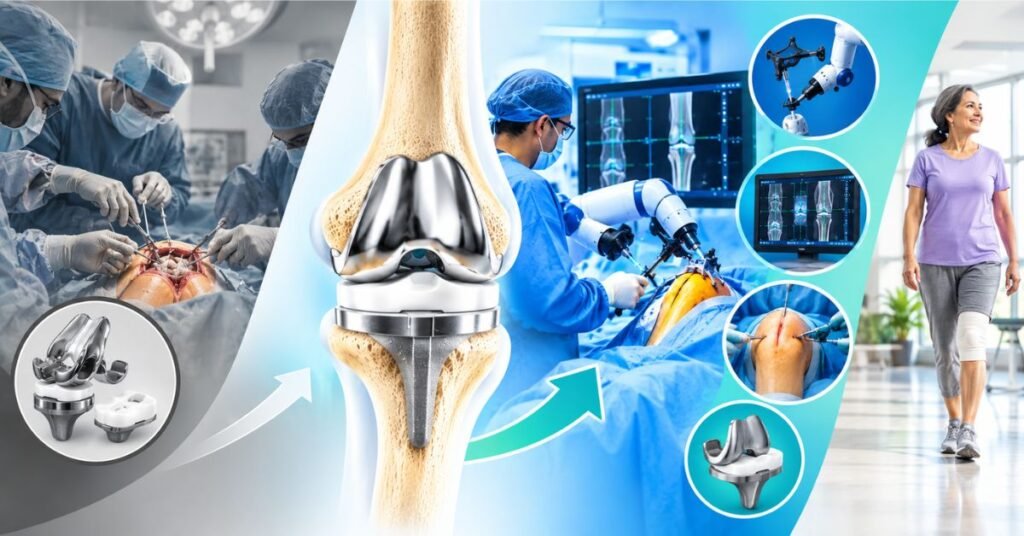
Our improvements in planning, alignment, implant positioning, pain control, and rehabilitation have transformed knee replacement surgery. But that doesn’t mean all patients need to have the latest technology. Instead, they give the treating team more options to customize treatment to the condition of the knee.
From standard to more individualized planning
Earlier knee replacement workflows depended on standard measurements and conventional instruments. Many centers today use detailed radiographs, and when appropriate, advanced imaging or digital planning to understand bone shape and alignment. This can prepare the surgeon for unusual anatomy or significant deformity before entering the operating room.
Increased Attention to Accuracy and Recovery
Computer navigation and robotic assistance can provide additional information intra-operatively. These systems are designed to support the surgeon in making and implementing decisions, not to supplant surgical expertise. Meanwhile, the development of anesthesia, pain-management protocols, infection-prevention practices, and physiotherapy has also created more structured recovery pathways.
What These Changes Mean to Patients
Surgery planning tailored to the individual
- Improved tools for implant position and alignment checks
- Early mobilization and structured rehabilitation in suitable patients
- More explicit discussion of risks, anticipated recovery and activity targets
The Site of Treatment of Knee Arthritis
Not everyone with knee arthritis has to have replacement. Depending on the symptoms, exercise therapy, weight management where appropriate, medicines, injections, activity modification and other non-surgical measures may be considered. If conservative treatment has not provided satisfactory relief, then a knee replacement surgeon in Indore can determine whether the surgery is indicated. The same goes for patients looking into knee arthritis treatment in Indore: the next step should be decided by symptoms, examination, imaging and response to non-surgical care.
To put it simply,
And the biggest change isn’t a machine or a technique. It is a broader shift to evidence based, patient specific planning and coordinated recovery. Instead of choosing a procedure based on technology alone, patients should ask how a proposed technique matches their anatomy and goals.
Technology is just one part of change
The surgical experience has also been more integrated. Preoperative assessment, anesthetic planning, prophylaxis of infection, pain management, physiotherapy and discharge planning are discussed together. “A pathway-based approach can make things more predictable, but still allow for changes when a patient has other medical needs.
Prior to surgery, patients can ask about the planned technique, why it was chosen, how the position of the implant will be verified, the rehabilitation process, and what activities can be resumed at different stages. These questions help turn technology into useful information, rather than a marketing term.


