
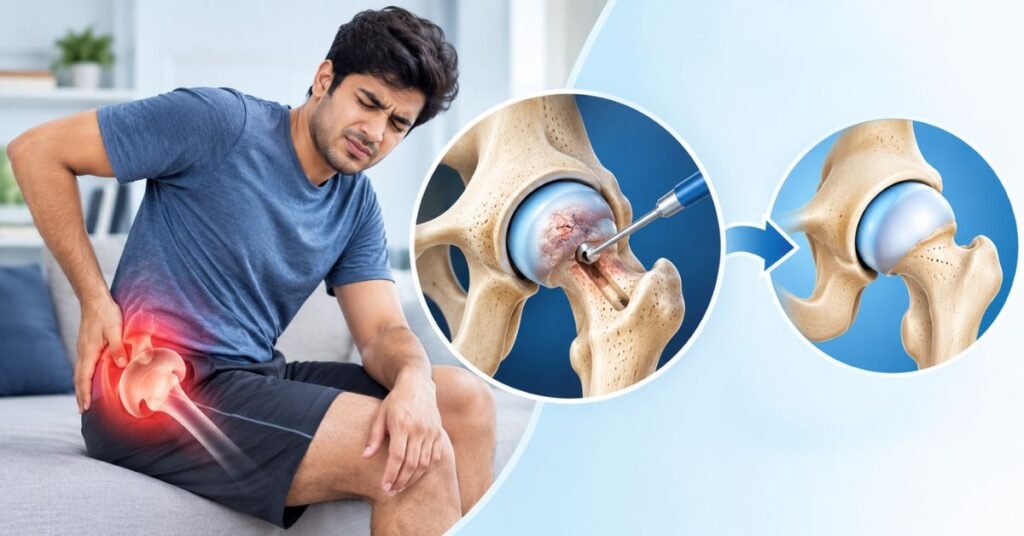
Hip discomfort is frequently connected with ageing but may also occur in younger persons. Persistent hip discomfort in your 20s, 30s or 40s, especially pain that gradually worsens while walking or exercising, shouldn’t be disregarded.
Another factor that can be present is avascular necrosis (AVN) of the hip . This is a disorder where the blood supply to the head of the femur is decreased or cut off . Without proper treatment, the damaged bone can become weaker and finally collapse, which can lead to severe arthritis and hip replacement.
Early stage AVN in selected patients may be treated with core decompression surgery as a hip saving procedure.
What Is Hip Avascular Necrosis?
Avascular necrosis is when blood flow to a portion of the hip joint (typically the femoral head) is interrupted. Reduced blood flow can cause bone tissue to die and deteriorate.
Over time the femoral head can lose its usual form and collapse. If there is a large amount of collapse or the joint is badly damaged, it may be required to have a hip replacement.
AVN possible risk factors include:
Corticosteroids for long periods or in high doses
Too much alcohol
Old hip injury
Particular health conditions
Previous treatment affecting blood flow to bone
Sometimes no apparent cause can be determined
Not everyone with these risk factors will get AVN, which is why persistent symptoms should be properly evaluated.
What Does Hip Pain From AVN Feel Like?
Early AVN may not have noticeable symptoms. As the disease advances, patients may develop:
Pain in the hip or groin
Pain when you move or stand
Pain during exercise
Hip stiffness
Limited hip mobility
Pain that may subsequently recur even at rest
Trouble walking long distances
If you’re a younger person with hip discomfort, it’s not always a pulled muscle, particularly if the pain doesn’t go away or gets worse.
Can Core Decompression Save Your Natural Hip?
Core decompression may be useful in some patients with early stage avascular necrosis to save the native hip joint and maybe postpone progression to collapse of the femoral head.
This is done by drilling a canal or channels in the diseased part of the femoral head. The aim is to relieve pressure in the bone and stimulate the body’s natural ability to mend.
However, not all stage of AVN is suited for core decompression. The prospects of success are usually better if the problem is diagnosed before considerable collapse of the femoral head.
This makes early diagnosis especially crucial.
Who Is a Candidate for Core Decompression Surgery?
Depending on considerations such, in some cases, a hip orthopaedic surgeon in Indore may opt for core decompression:
Stage of AVN
In case of collapse of the head of the femur
Size and location of the impacted area
Symptom severity
Age and activity of the patient
General Health
X-Ray or MRI Results
In particular, an MRI can be effective in diagnosing early AVN when X-rays have not yet revealed any visible abnormalities.
How do they do core decompression surgery?
Core Decompression Surgery in Indore The surgeon makes a controlled path into the afflicted portion of the femoral head.
The purpose of the technique is to:
Decreased pressure in the afflicted bone.
Damaged bone removal or decompression
Promote healing
Wherever possible, preserve the native hip joint
May postpone progression to joint collapse
In some circumstances, depending on the patient’s health, further treatments or biological materials may be considered.
Your orthopaedic surgeon will review the best way forward after assessing your hip.
Can core decompression avoid the need for hip replacement?
This is one of the most typical worries among younger patients.
Core decompression can be a way to delay or avoid hip replacement in adequately selected patients with early stage AVN. But that doesn’t mean you won’t need a hip replacement.
The result relies on the stage of AVN, extent of the lesion, if the femoral head has collapsed already and individual patient characteristics.
Hip replacement may be a better choice if there is significant collapse or severe arthritis at the time of presentation.
Why is early diagnosis so important?
AVN may progress with minimal symptoms in the early stages. When the pain is severe, the disease may have already advanced.
Early diagnosis allows your orthopaedic physician to assess if hip-preserving therapies like core decompression are suitable.
If you experience inexplicable, ongoing hip or groin discomfort – especially if you’re quite young – don’t just keep taking painkillers without figuring out the underlying cause.
How Is AVN Diagnosed? What Tests Are Done?
Depending on your symptoms and exam, your doctor may want imaging.
Possible tests:
X-Ray
X-rays may reveal abnormalities in the hip joint especially in the latter stages of AVN.
MRI;
MRI may detect early changes in the bone and may pick up AVN before there are noticeable abnormalities on an x-ray.
Clinical assessment
Your orthopaedic surgeon will also examine how your hips move, how much pain you have, how well you walk and other symptoms.
What Is Recovery After Core Decompression Like?
Recovery depends on the stage of AVN, surgical approach, and individual healing.
Your surgeon may suggest:
Temporary limits on weight bearing
Walking aid or crutches Physiotherapy
Progressive resistance exercises
Imaging follow-up
Slow return to normal activities
Adhering to the specified rehabilitation plan is vital to safeguard your hip as it heals.
Hip Replacement Vs. Core Decompression
The two methods are aimed at different aims.
Early AVN in certain circumstances may be generally indicated for core decompression with the goal of preserving the patient’s native hip.
Hip replacement is when the damaged parts of the hip joint are replaced with artificial parts. It may be indicated when the head of the femur has collapsed or where there is significant damage to the joint.
So the question is not only which procedure is superior. Treatment mainly relies on the stage of the disease.
When to visit a hip orthopedic surgeon in Indore?
If you have: You might want to consider an orthopaedic assessment.
Persistent pain in the hip or groin area
Pain when walking
It is hard to exercise because of pain in my hip
Increasing rigidity
Decreased hip mobility
Pain that is getting worse and worse
Hip Pain Following Injury
Known risk factors for osteonecrosis
A hip orthopedic surgeon in Indore will be able to assess your symptoms and determine if further imaging, conservative treatment, core decompression or any other treatment is indicated.
Does core decompression apply to all patients with AVN?
No. It is usually reserved for chosen individuals, especially when AVN is identified before substantial collapse of the femoral head.
Can core decompression treat avascular necrosis completely?
The aim of core decompression is to control early disease and to salvage the hip, although it does not hold out the promise that the evolution of AVN will cease.
Does AVN always produce hip discomfort in young adults?
No. There are a variety of causes of hip pain. A proper clinical evaluation is required to find out the underlying issue.
Don’t Ignore Hip Pain in Your 20s
Not all hip pain in a younger adult should be discounted as muscular strain or overuse. Avascular necrosis, if left untreated, can worsen and eventually destroy the hip joint.
If AVN is diagnosed early, Core Decompression Surgery in Indore can be an alternative for chosen patients who want to keep their natural hip.
If you experience ongoing discomfort in your hip, seek the expertise of a hip orthopedic surgeon in Indore for a proper diagnosis and tailored treatment regimens. Early evaluation might help establish if a hip conserving technique is right for your condition.