
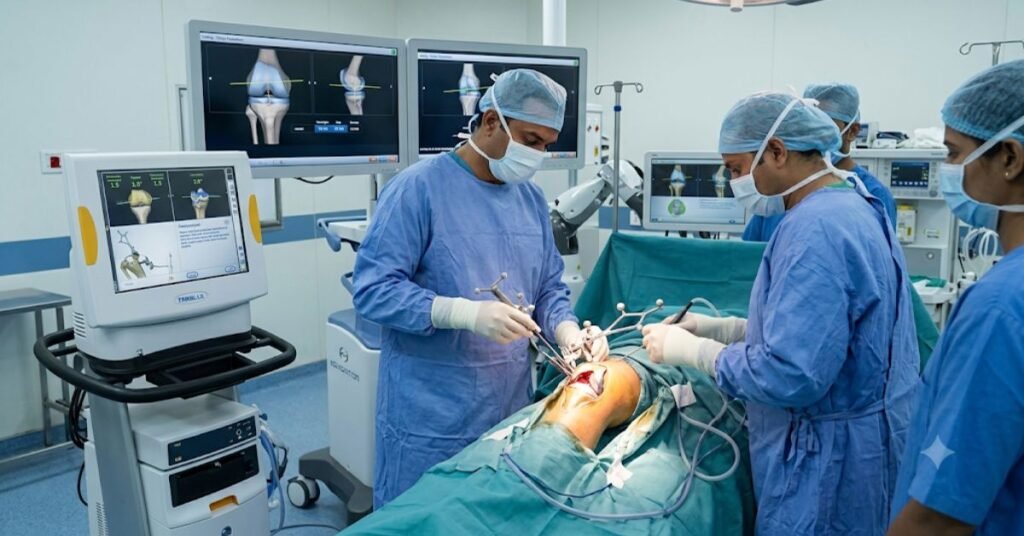
Knee replacement assisted by computer uses digital navigation to provide the surgical team with extra information on the alignment of the limb, bone cuts, and implant placement during the procedure. It is designed to be a tool of support for the surgeon, especially when precise alignment is critical to the individual patient.
How Computer Help Works
Before or during surgery, the system takes anatomical information and builds a digital model of the knee and leg. Sensors and instruments can then provide measurements to assist the surgeon in confirming the planned position of implants and the relationship between the femur, tibia, and overall limb alignment.
Benefits:
- Real-time feedback during the critical steps of the operation
- More detailed assessment of alignment and part position
- Helpful planning assistance for challenging anatomy or deformity
More transparency of measurements that are difficult to judge with the eye alone
Is it suitable for all?
A computer can help but it’s just a tool, not a guaranty of better results. The choice is determined by the surgeon’s experience, the patient’s anatomy, the implant system, and the clinical situation. There are still many knee replacements where conventional instruments are appropriate.
What Patients Can Ask
If you are a patient considering knee replacement surgery in Indore, you can ask if computer navigation is available, why it is recommended, what it adds to the planned procedure, and if the surgeon expects it to alter the rehabilitation plan. Your orthopedic surgeon in Indore can tell if navigation is likely to provide meaningful information in your situation.
The goal of computer-assisted knee replacement is to provide more information and control during the operation. The orthopedic surgeon makes the final decisions, combining navigation data with clinical examination and surgical experience.
When Navigation Could Be Most Useful
Navigation can be helpful when the surgeon needs additional information about a difficult alignment problem, unusual anatomy, or prior to surgical changes. It can also provide a record of measurements at critical points in the operation. The exact role of navigation is system-dependent and surgeon-dependent.
Limits of Computer Help
A navigation system is not a substitute for preoperative assessment or surgical skills. Accurate registration, correct instrument use and correct interpretation by the surgeon of the information in relation to the patient’s anatomy, and soft tissues are all required. For this reason technology should be viewed as a help, not a solution.
A Realistic Goal
The practical objective is to help the surgeon reproduce the desired alignment and implant position with useful measurements during the procedure. Patients should always assess a technique based on its appropriateness for their individual condition, not simply the technology.


