
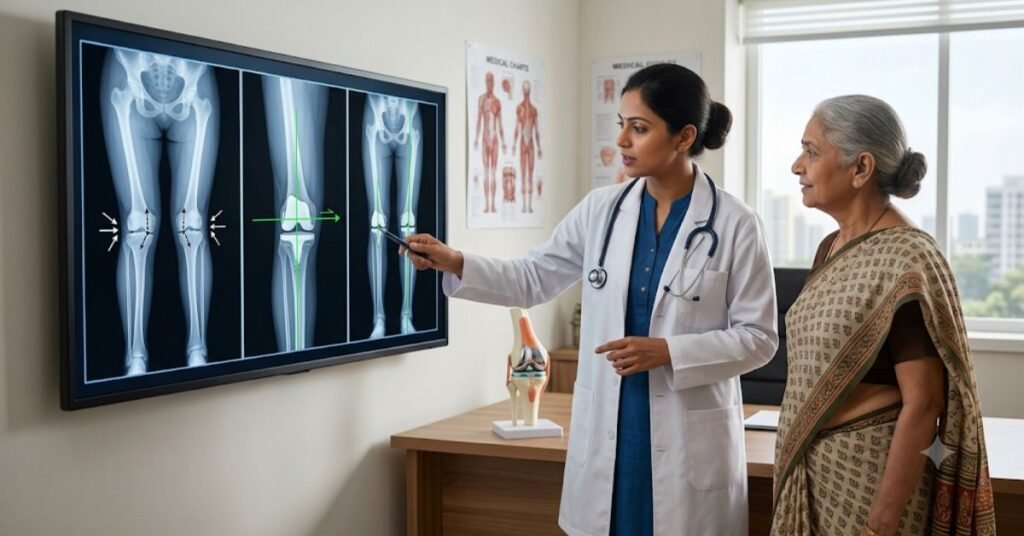
Knock knees (genu valgum) are an alignment where the knees angle toward each other. In adults, severe valgus alignment may be associated with arthritis and may cause knee instability or pain. The need for replacement depends on the condition of the joint, not on the appearance of the legs alone.”
When Knock Knees Lead to a Knee Problem
Knee pain, stiffness, swelling, inability to walk as far, or difficulty using stairs can be caused by arthritis that destroys cartilage and changes the shape of the joint. A clinical examination and standing X-rays will determine the severity of arthritis and the extent of alignment change.
How Knee Replacement Can Help
Replacement: The surgeon cuts the damaged surfaces of the joint and inserts parts of an implant in a predetermined position. If the deformity is flexible, it may be more easily corrected. A fixed or severe valgus deformity can be more technically challenging as the surrounding ligaments and bone may have to be carefully balanced.
Important Aspects of Decision Making
- Pain severity and cartilage degradation
- Flexibility and degree of severity of the valgus deformity
- Condition of collateral ligament
- Bone loss, previous surgeries
- Responding to appropriate non-surgical treatments
Understanding Treatment of Deformities
Depending on the diagnosis, Knee Deformity treatment in Indore may consist of non-surgical measures or surgery. Replacement is usually considered when there is significant pain and functional limitation, and the damaged joint is unlikely to improve with conservative management.
Knee replacement can correct some knock-knee deformities that are related to arthritis, but the surgery needs to be tailored to the individual’s anatomy. After examination and imaging, a knee replacement surgeon in Indore will explain the likely approach.
Why Fixing Knock Knees is More Complicated
Valgus deformity may change the shape of the femur and tibia and may alter the tension of the surrounding ligaments. The surgeon has to keep all of these things in mind while holding stability. Imaging and a complete physical exam determine the amount of complexity before surgery.
What to Expect After Surgery?
Recovery means wound care, safe mobility, knee motion, activation of muscle, and progressive strengthening. Rehabilitation is not the same for all patients just because they have a pre-existing deformity. Follow-up visits allow the team to track healing and functional progress.
It’s important to do a full assessment
If the knock-knee alignment is severe, it may affect adjacent ligaments and bone, so a surgeon may need detailed imaging and careful examination before deciding on the implant and surgical technique. This is especially important in the case of prior trauma or surgery.


