
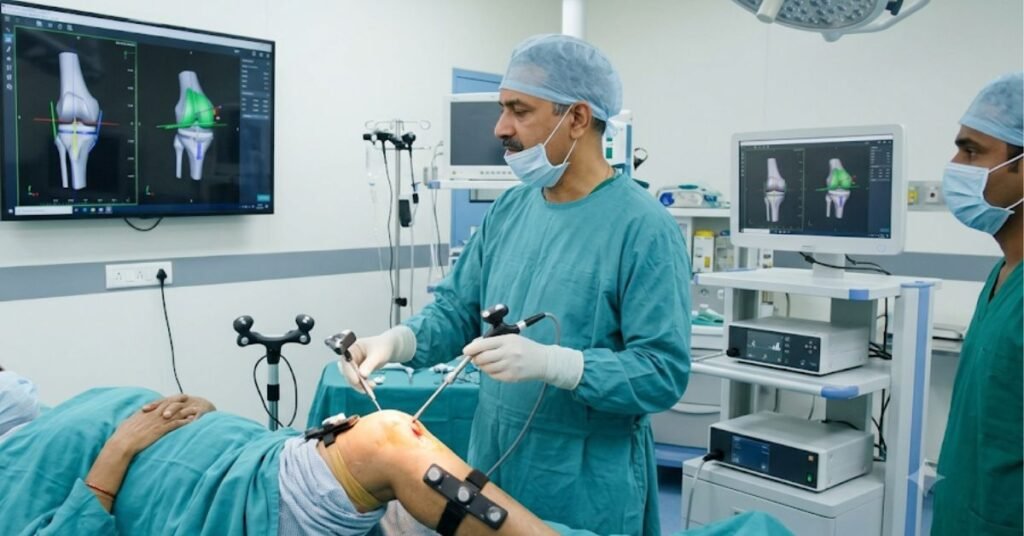
Computer navigation in total knee replacement can improve the information available by illustrating measurements regarding alignment and bone preparation. This can be helpful if a surgeon wants additional feedback on positioning implants or balancing the knee.
More information during the operation
In traditional surgery, alignment is determined by mechanical guides, visual markers, instruments, and measurements. Navigation creates a digital layer. It can track chosen points on the leg and demonstrate how small changes in bone preparation affect the alignment. This is not the surgery. It is helping the surgeon to see what is being done.
Why is Alignment Important?
The knee must be stable through motion, and the implant components must work with the patient’s anatomy. Additional navigation information may be useful when deformity, abnormal bone shape or prior surgery make landmarks less obvious. But even so, you still have to factor in ligaments, soft tissues, bone quality, and the patient’s goals when you’re planning surgery.
Navigation versus Conventional Methods
- Traditional instruments well known, common and appropriate for many patients.
- Computer navigation: Provides real-time digital measurements and may help with individual planning.
- Both techniques rely on surgical judgment, appropriate selection of implant and careful postoperative rehabilitation.
Role in the Management of Arthritis
Before replacement, patients with advanced arthritis may be comprised of non-surgical care. Knee arthritis treatment Indore If surgery is required, the orthopedic team can talk about the value of computer navigation in that particular case.
The best way to think of computer navigation is as a precision support system. Its value is in how it is used in a complete surgical plan and not just the technology per se. A knee replacement surgeon in Indore will help you understand if navigation adds a practical benefit for your anatomy and treatment plan.
Is More Information Always Better Surgery?
Not really. More measurements are useful if they answer a relevant clinical question. For a simple knee replacement, the surgeon may get all the information he needs from traditional instruments. Navigation can add useful details to a complex situation. Therefore, the appropriate choice is individualized.
After the Operation
Computer navigation is usually not a separate form of rehabilitation. Recovery depends on many factors including the type of surgery, pain control, muscle strength, range of motion, general health, and dedication to physical therapy. Patients are encouraged to adhere to their treating team’s prescribed postoperative plan.
Talking about The Right Choice
During consultation ask if your case has any alignment or anatomical features for which navigation is particularly useful. If you have an explicit explanation, without assuming that computer assisted surgery is necessary for every patient, you can understand the expected benefit.


