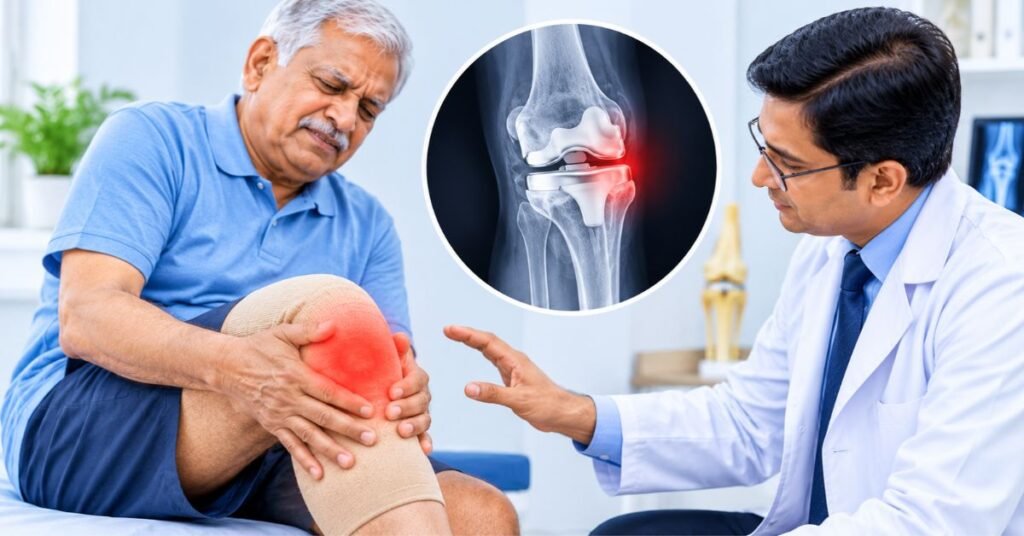
Most patients benefit from knee replacement, but a small number still have pain, swelling, instability or stiffness or develop problems years later. In these cases, failed knee replacement starts with finding out the reason for failure of the implant.
Common causes of failure
- Loosening of implants
- Infection
- wear of plastic part
- Ligamentous imbalance or instability
- Stiffness or scar tissue
- Implant Misalignment
- Fracture surrounding the implant
- Pain that comes from the hip or spine
Warning signs
- Pain that gets worse or does not go away
- Heat or swelling
- Feeling like the knee buckles
- Less movement
- Pain on initiation of walking
- Fever or problems with a wound
Diagnosis:
Evaluation includes physical examination, X-rays, blood tests, and sometimes CT scans, nuclear scans, or joint fluid aspirations. Infection must always be excluded because it alters management.
Treatment options
Not every painful replacement requires surgery. Some problems respond to physiotherapy, bracing, medication, or manipulation under anesthesia for stiffness. If the problem is structural, such as loosening, wear, instability, or infection, a revision of surgery may be recommended. Sometimes only one part is exchanged, sometimes the whole implant.
Timing is key in evaluation
Delaying treatment can lead to bone loss, which makes surgery later more difficult.
Rebuild
Rehabilitation aims at getting back movement, strength, and walking. Recovery depends on the procedure and your general health.
For a good, knee replacement treatment in Indore, the first thing that is needed is accurate diagnosis and a plan suited to the cause. If your knee replacement is not giving you the relief you were hoping for, book a consultation for a careful assessment.