
Successful Distal Femoral Replacement with Rotating Hinge Knee for 6-Year-Old Distal Femur Nonunion in an 84-Year-Old Patient
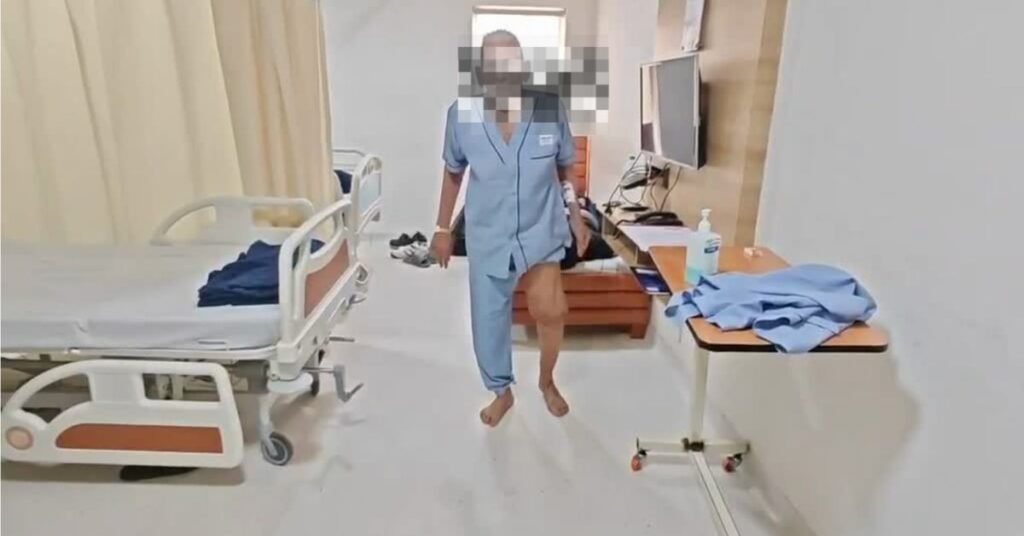
Patient's Initial Condition
Symptoms / Health Concerns
● Severe pain in the left knee
● Difficulty walking
● Inability to perform routine daily activities
● Progressive knee instability
● Painful and restricted knee movement
● Long-standing distal femur nonunion
● Significant bone loss and destruction around the distal femur
● Previous failed surgical fixation
Duration of Symptoms
The patient had sustained a left distal femur fracture approximately 6 years earlier, which was treated elsewhere with plate fixation.
Over the following years, he gradually developed increasing pain, instability, and progressive difficulty walking. Despite the previous fixation, the fracture failed to unite and eventually resulted in severe destruction and instability around the knee.
There was no history of recent trauma, fever, or constitutional symptoms.
Previous Treatments
● Left distal femur fracture treated approximately 6 years earlier
● Plate and screw fixation performed elsewhere
● Progressive pain and instability following the initial surgery
● Gradual deterioration in walking ability
● Failure of fracture union despite previous fixation
Diagnosis
Final Diagnosis
● Distal Femur Nonunion
● Failed Distal Femur Fixation
● Severe Bone Loss and Destruction of the Distal Femur
● Significant Knee Instability
● Intercondylar Separation
● Painful and Restricted Knee Movement
● Failed Previous Surgical Fixation
Tests / Scans / Investigations
● Routine hematological investigations
● Routine biochemical investigations
● Preoperative radiographs and imaging
● Assessment of previous fixation hardware
● Evaluation of distal femoral bone loss
● Assessment of nonunion and knee instability
● Intraoperative assessment for evidence of infection
Treatment Details
Distal Femoral Replacement (Mega Prosthesis) with Rotating Hinge Total Knee Arthroplasty
Considering the patient's advanced age, extensive distal femoral bone loss, severe instability, and long-standing nonunion, conventional fixation or revision fixation was not considered suitable.
After detailed counselling, the patient underwent distal femoral replacement using a metallic mega prosthesis combined with a rotating hinge knee replacement.
Duration: The surgery was performed under spinal anesthesia with epidural catheter support for postoperative pain management. Total operative time: Approximately 2 hours 30 minutes.
Advanced Techniques Used
● Removal of previous failed fixation hardware
● Assessment and excision of nonviable distal femur
● Distal femoral resection
● Metallic distal femoral mega prosthesis reconstruction
● Rotating hinge total knee arthroplasty
● Sequential femoral and tibial canal preparation
● Intraoperative trialing for optimal alignment and stability
● Restoration of limb length
● Careful soft tissue balancing
● Antibiotic irrigation
● Postoperative neurovascular monitoring
● Early mobilization with walker support
Results & Recovery
Patient Improvements
● Failed fixation hardware was completely removed
● Nonunited and severely damaged distal femur was excised
● Distal femur was successfully reconstructed with a mega prosthesis
● Knee stability was restored
● Limb alignment was corrected
● Limb length was restored
● Satisfactory range of motion was achieved
● Postoperative neurovascular status remained normal
● Significant pain relief was achieved
● Early mobilization was possible
● Walking ability progressively improved
● The patient showed satisfactory functional recovery
Recovery Duration: The patient had an uneventful postoperative recovery and was mobilized early with walker support. Progressive improvement in walking ability and pain was observed during recovery.
Final Outcome
The patient underwent successful distal femoral replacement with a rotating hinge mega prosthesis for long-standing distal femur nonunion, severe bone loss, and instability following failed fixation.
The surgery restored limb alignment, knee stability, limb length, and functional movement. The patient experienced satisfactory pain relief and was able to begin mobilization with walker support from the first postoperative day.
The overall recovery was uneventful, with progressive improvement in ambulation and quality of life.
Returned to Normal Activities: Yes
Case Highlights
What Makes This Case Unique
This was a challenging and complex orthopedic case involving an 84-year-old patient with a 6-year-old distal femur nonunion following failed plate fixation.
The patient presented with severe pain, marked knee instability, restricted movement, and difficulty walking. Imaging demonstrated significant bone loss and destruction around the distal femur, making conventional revision fixation unsuitable.
Considering the patient's advanced age, extensive bone loss, and severe instability, distal femoral replacement with a rotating hinge mega prosthesis was selected as a limb-salvage and functional reconstruction procedure.
The surgery successfully restored limb alignment, length, stability, and functional movement while allowing early postoperative mobilization.
Complex / Rare Factors
● 84-year-old patient
● Long-standing distal femur nonunion
● Failed plate fixation
● Six-year history following the original fracture
● Severe distal femoral bone loss
● Intercondylar separation
● Significant knee instability
● Restricted knee movement
● Major reconstructive surgery
● Distal femoral mega prosthesis
● Rotating hinge total knee arthroplasty
● Need for blood transfusion
● Requirement for early rehabilitation and mobilization
Most Significant Benefit
The most significant benefit was the ability to achieve stable limb reconstruction and early mobilization despite extensive distal femoral bone loss and long-standing nonunion.
Distal femoral replacement with a rotating hinge mega prosthesis provided immediate mechanical stability, restored limb alignment and length, improved knee function, and helped reduce the need for prolonged immobilization associated with revision fixation.
For an elderly patient with severe bone loss and instability, this approach offered an effective limb-salvage option with the goal of improving mobility and overall quality of life.
Conclusion
This case highlights the role of distal femoral replacement with a rotating hinge mega prosthesis as an important treatment option for elderly patients with failed distal femur fixation, long-standing nonunion, severe bone loss, and knee instability.
An 84-year-old male patient presented with severe left knee pain, instability, restricted movement, and difficulty walking six years after a distal femur fracture treated with plate fixation. Imaging revealed failed fixation, nonunion, and extensive distal femoral destruction.
After detailed counselling, the previous hardware was removed and the nonviable distal femur was excised. Reconstruction was performed using a distal femoral mega prosthesis combined with rotating hinge total knee arthroplasty.
The procedure achieved satisfactory limb alignment, soft tissue balance, joint stability, range of motion, and limb length restoration. Postoperative radiographs showed satisfactory implant positioning, and mobilization with walker support was initiated on the first postoperative day.